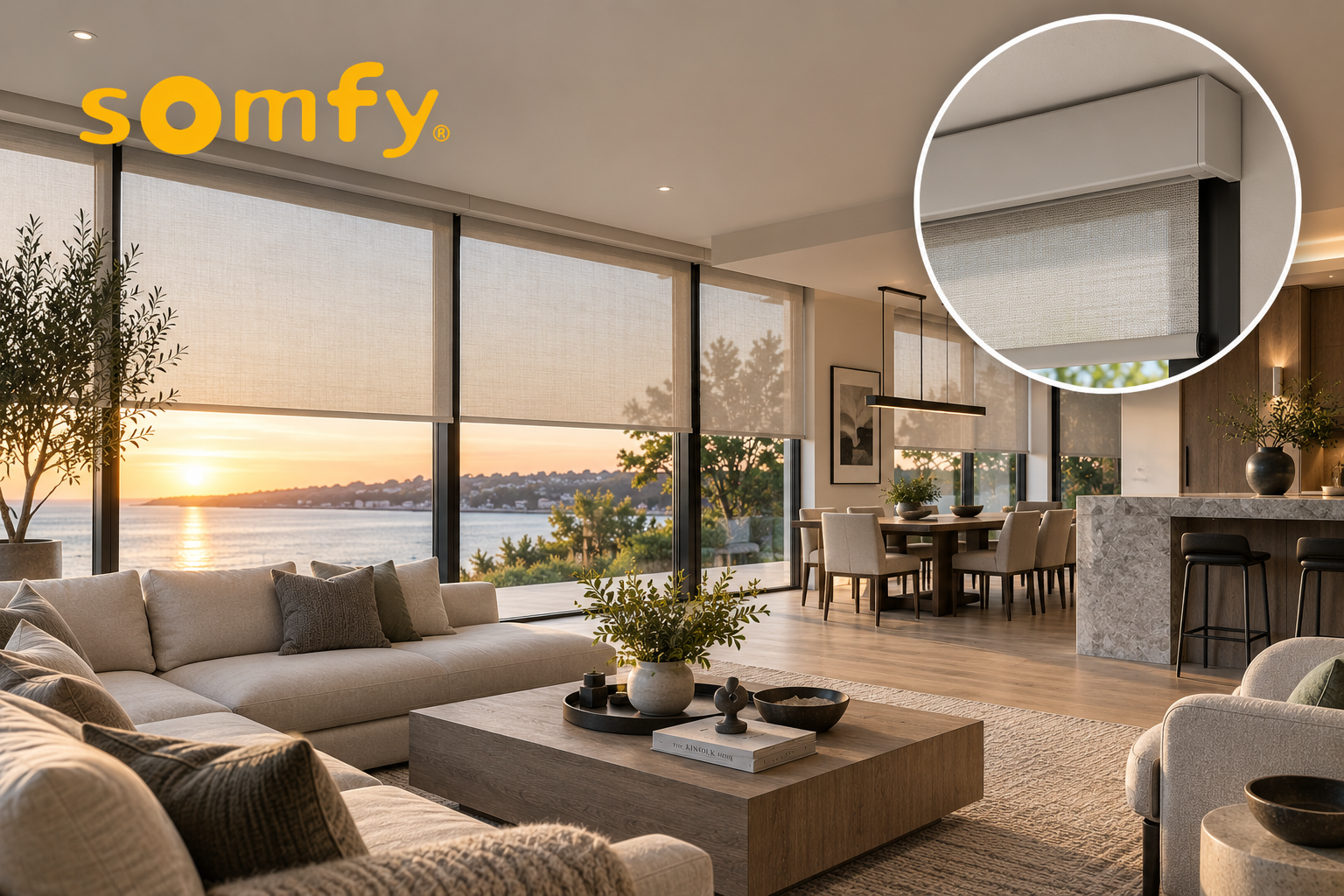

A motorization company first
Somfy was founded in Cluses, France, in 1969. Its early work centered on tubular motors for blinds and rolling shutters, a technical foundation that helped move window coverings away from manual cranks and toward powered operation.
The company’s history is unusually tied to the mechanisms behind the finished shade. It later expanded into radio control, centralized operation, connected products, and partnerships with other home technology platforms. Somfy also acquired Simu, a competing motorization company, in 1990.
Curious what this looks like in your own house?Contact the Daisy Gulf Coast team to understand the possibilities.
What Somfy brings to a shade project
Somfy motors can be used in roller shades, blinds, drapery, awnings, and exterior openings. The system may be battery powered, wired to the home, or designed around a combination of local controls and radio communication.
That range gives a designer flexibility, but it also makes the project more technical than choosing a fabric. Window size, shade weight, access to power, sunlight, and the desired control method all matter. A battery solution may simplify a retrofit. A hardwired installation may be the better long-term choice for a new build with many windows.
Integration is the important layer
Somfy is not itself the complete answer to every smart-home question. Its motors need to work within a larger control plan if the homeowner wants shades to participate in lighting, climate, security, or entertainment scenes.
That is where compatibility with platforms such as Lutron and Control4 becomes relevant. The exact bridge, protocol, and system architecture should be confirmed before the order is placed. A shade that operates correctly by remote may still need additional planning to respond to sunrise, glare, occupancy, or a whole-home scene.
The selection questions that matter
Somfy’s strength is breadth and motorization experience. Its limitation is that the finished result still depends on the shade manufacturer, fabric, installer, and control design around it. A motor cannot fix a poor mount, an unsuitable openness factor, or a window treatment that was chosen without regard to the room.
Homeowners should ask how the shades will be powered, what happens during an outage, how manual operation works, and whether replacement parts will remain accessible. They should also look at the room in different seasons. Gulf Coast light, humidity, and large glass openings can make glare control and heat management central to the design.
Somfy is best understood as infrastructure. When the motor and control layer are specified well, the finished shade can feel less like a machine and more like a natural part of the room.
A motor cannot fix a poor mount, an unsuitable openness factor, or a window treatment that was chosen without regard to the room.