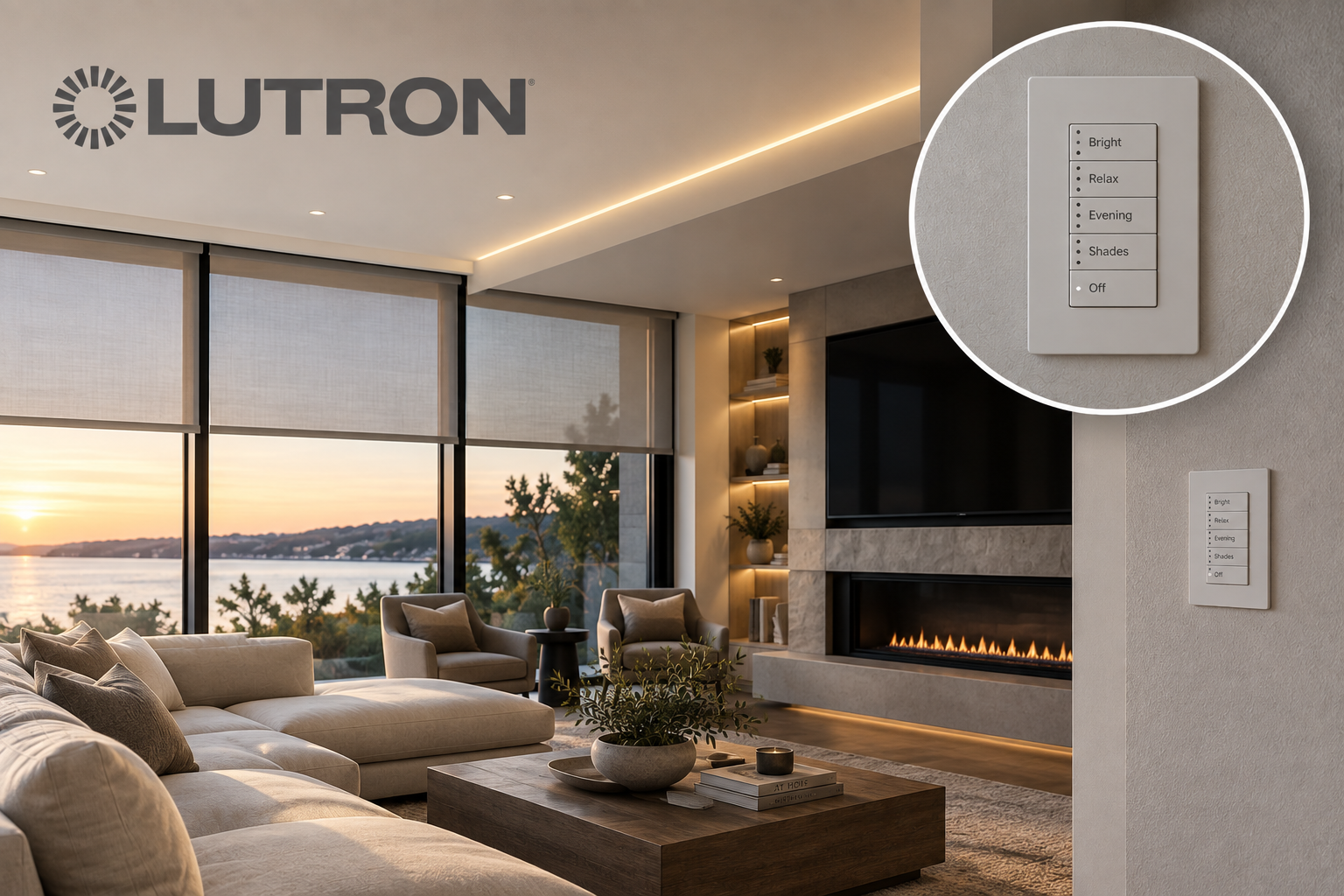

A lighting company with a systems view
Lutron began with a problem that sounds simple until it is considered closely: how to control electric light without compromising the way a room looks or feels. Ruth and Joel Spira founded the company in 1961. The first chapter was built around the dimmer, but the larger idea was always more ambitious. Light should be adjustable, intentional, and part of daily life rather than a binary decision.
That point of view still explains much of Lutron’s position. The company’s reputation rests on the design of its controls, product consistency, and the way lighting can be coordinated across a home.
Curious what this looks like in your own house?Contact the Daisy Gulf Coast team to understand the possibilities.
From dimmers to the whole light environment
In a contemporary home, electric light is only half of the picture. Sunlight changes by the hour, and windows can bring both atmosphere and glare. Lutron’s residential systems bring lighting controls and automated shades into the same conversation, allowing a homeowner to manage the total light in a room rather than treating lamps and window coverings as separate chores.
That relationship is where the brand becomes more interesting than a collection of smart switches. A morning scene might open shades and raise light levels. A film scene might lower both. An evening setting might close the brightest exposures while leaving circulation paths softly lit.
The most convincing scene is usually the one that feels like a natural change in the room, not a performance by the house.
Why the controls matter
Luxury lighting control often succeeds or fails at the wall. The keypad needs to be understandable in a hurry, comfortable to touch, and appropriate to the architecture around it. Lutron’s product families offer different approaches to that interface, from familiar dimmers and switches to engraved keypads and higher-end metal finishes.
That physical attention is part of the reason integrators continue to specify the brand. A system can be powerful behind the scenes, but the homeowner experiences it through a button, a sensor, a remote, or an app. If those points of contact feel confusing, the sophistication of the rest of the installation is beside the point.
Where Ketra fits
Ketra adds a more precise layer to the lighting conversation. Acquired by Lutron in 2018, the brand is associated with color-tunable lighting that can shift the quality of light through the day and support different moods or settings.
For a designer, that can be valuable when the room depends on the relationship between light and material. Stone, wood, paint, and textiles do not look identical under every color temperature. The useful result is control over atmosphere and the way finishes are perceived.
Ketra also raises an important question for homeowners: do you need advanced color tuning everywhere? Often the answer is no. It may be most useful in rooms where light quality is central to the experience, while simpler, well-designed control is the better choice elsewhere.
Why integrators install it
Integrators tend to choose Lutron when a project needs dependable lighting control, coordinated shades, a considered physical interface, and room to grow. The system can serve a single room or become part of a wider residential platform that includes sound, temperature, and other home functions.
That flexibility does not remove the need for design decisions. Shade fabric, window geometry, fixture selection, wiring, keypad locations, and scene logic all influence the result. Lutron provides the tools, but the quality of the home still depends on how those tools are specified and commissioned.
The limitation is also the lesson
Lutron is not the right answer simply because it is well known. Its value appears when a home has enough complexity for coordinated control to matter, or when the client cares deeply about the quality of the interface and the behavior of light.
In a small space with a few lamps, a simpler solution may be perfectly adequate. In a large Gulf Coast home with glass, layered lighting, shades, and multiple modes of living, Lutron’s systems view is easier to appreciate.
Lutron is worth considering when lighting, shades, interfaces, and room-by-room scenes need to work as one designed system. Its strongest contribution is a disciplined view of technology as part of the room, not a separate layer competing with it.