
A history in architectural audio
Origin traces its roots to a Riverside, California stereo store founded by Ken Humphries and Ed Haase. The company says the pair developed an early flush-mount loudspeaker in the 1980s, then went on to build architectural products for other names in the industry. Origin Acoustics launched as its own brand in 2014, with Jeremy Burkhardt among its founders.
That history gives the company a different perspective from a traditional hi-fi manufacturer. Its products are designed for rooms where the speaker location, grille, depth, and finish are part of the construction conversation from the beginning.
Curious what this looks like in your own house?Contact the Daisy Gulf Coast team to understand the possibilities.
The idea behind invisible audio
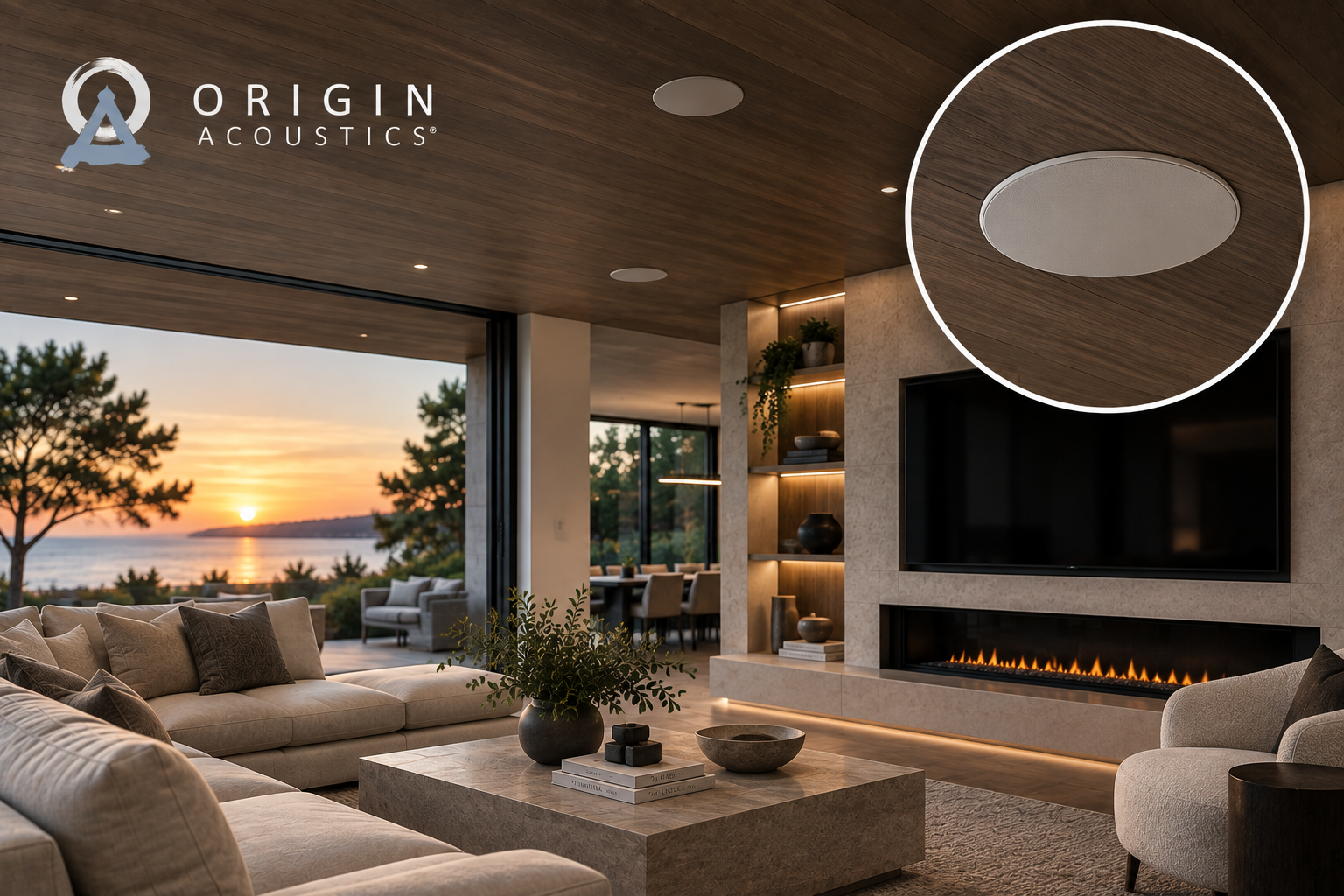
In-ceiling and in-wall speakers are not invisible in the literal sense. They still need a suitable cavity, correct placement, and a finish that works with the surface around them. What they can do is remove the visual weight of a cabinet from the floor or a console.
Origin’s architectural range includes in-wall, in-ceiling, outdoor, and specialty options. The useful comparison is not simply how small the grille looks. It is how evenly the system covers a room, how it handles voices and music, and how serviceable it remains after the walls are finished.
Why integrators specify it
Integrators often choose Origin when a project needs distributed audio across several rooms and the design brief calls for a quiet visual footprint. The brand also offers a broad catalog, which gives a designer room to choose different formats for a kitchen, theater, bedroom, porch, or dedicated listening room.
The result depends heavily on specification. A speaker placed for convenience may sound uneven or project toward the wrong part of the room. Good placement considers seating, ceiling height, reflections, cabinetry, and how the space connects to adjacent zones.
Where the tradeoffs appear
Architectural speakers save visual space, but they do not eliminate acoustic decisions. A high-performance in-wall system may require more planning than a pair of attractive floor-standing speakers. Outdoor products face their own exposure, coverage, and maintenance questions.
There is also a difference between hiding a speaker and making it disappear acoustically. A grille can be painted, but it still needs to remain open enough for the sound to pass cleanly. The best result balances concealment with honest expectations about performance and access.
Origin Acoustics is most compelling when the audio system is being planned as part of the architecture. It gives designers and integrators a way to make music present throughout the home without making equipment the dominant visual story.
The best result balances concealment with honest expectations about performance and access.