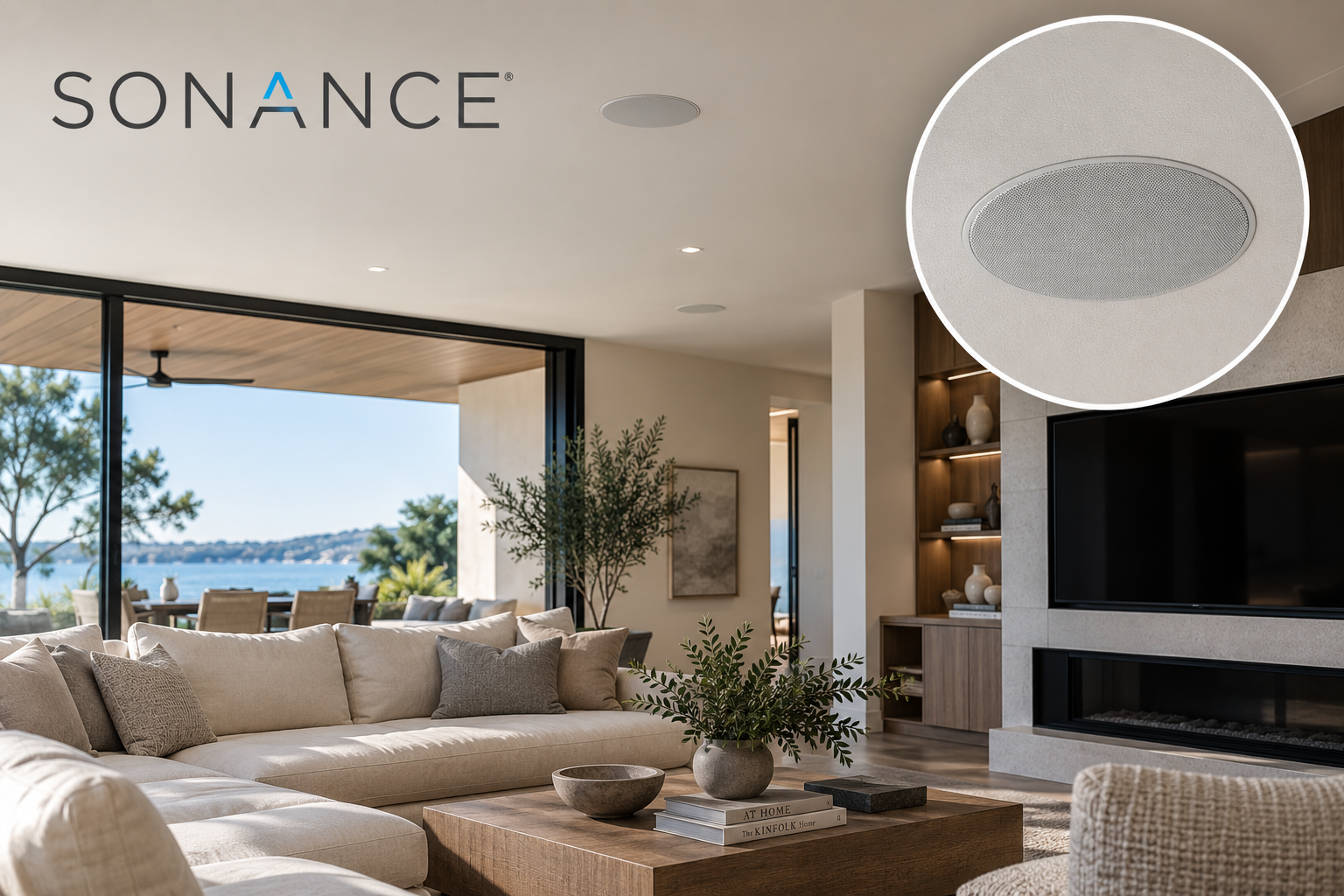

The company behind the category
Sonance says founders Scott Struthers and Geoff Spencer introduced the company in 1983 and developed the Sonance 1, an early in-wall loudspeaker. The company later expanded into in-ceiling, invisible, landscape, marine, and commercial solutions under the Dana Innovations organization.
The historical point matters because architectural audio was not always a standard part of residential design. Sonance helped make the category legible to architects, designers, installers, and homeowners who wanted distributed sound without a room full of visible cabinets.
Curious what this looks like in your own house?Contact the Daisy Gulf Coast team to understand the possibilities.
From in-wall speakers to invisible surfaces
Sonance’s catalog now covers several ways of placing sound. Traditional in-wall and in-ceiling speakers use a visible grille that can be painted to recede into the room. Invisible models push the idea further by placing the transducer behind a finished surface, while landscape systems distribute sound outdoors without relying on one loud point source.
Those are different tools, not interchangeable labels. An invisible speaker may suit a clean plaster wall, while an in-ceiling model may be more practical in a kitchen or hallway. Outdoor coverage requires another set of choices involving weather, planting, seating, and neighbors.
Why the integrator channel matters
Architectural audio is difficult to judge from a product photograph. Placement, back-box conditions, amplification, calibration, and the finish around the speaker all affect the experience. That is why Sonance has maintained a strong relationship with custom installers and design professionals.
For a homeowner, the relevant question is less about selecting the most impressive specification and more about deciding where music belongs. A living room may need balanced background sound, while a theater needs focused performance and a porch needs even coverage at a lower level.
Architectural audio is difficult to judge from a product photograph.
What to consider before specifying it
Sonance products can reduce visual clutter, but they do not make planning optional. The speaker should be located around how the room is used, not simply where a ceiling joist happens to allow it. Grille finish, paint, moisture, and future service should also be part of the discussion.
The brand’s broad range is a strength, although it can make the catalog feel dense. The right family depends on the room, the listening expectation, and whether the priority is invisibility, coverage, or a more concentrated listening experience.
Sonance remains important because it treats sound as an architectural material. Its strongest work is not about making a speaker disappear at any cost. It is about letting music occupy the room while the room keeps its visual identity.