
A professional-audio beginning
K-array traces its roots to a company founded in 1990 in the hills near Florence, Italy. The brand developed through live entertainment and professional sound, where compact equipment, power, and transport all matter. It later expanded toward architectural and residential applications.
That background distinguishes K-array from brands whose primary language is the flush-mounted architectural speaker. K-array often disappears through proportion and placement rather than by becoming completely hidden behind a finished surface.
Curious what this looks like in your own house?Contact the Daisy Gulf Coast team to understand the possibilities.
Slim form as an architectural tool
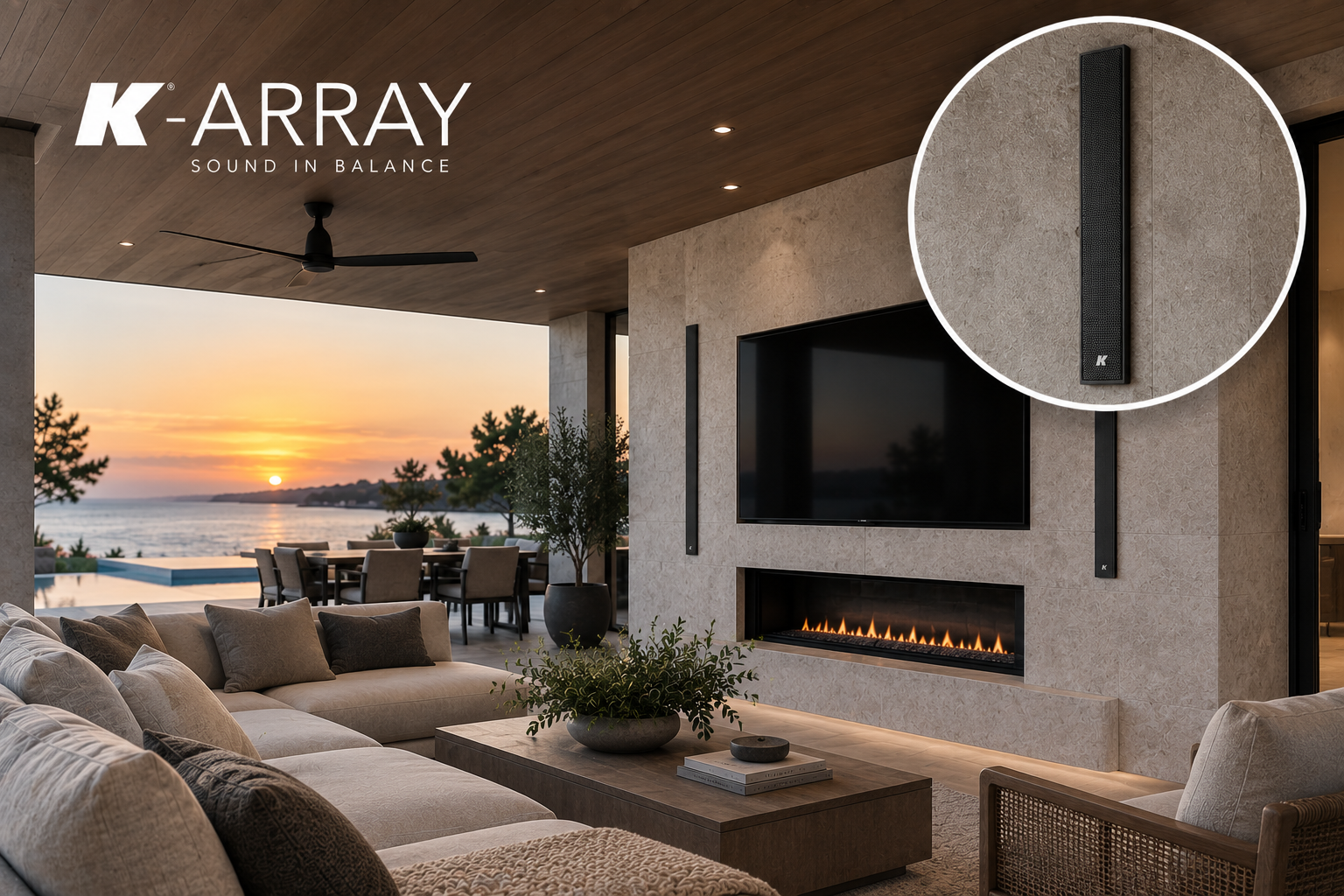
The company is known for narrow line-array loudspeakers and compact systems built with metal structures and customizable finishes. A slim speaker can work beside a screen, within a wall reveal, along a bar, or in a room where a round ceiling grille would feel out of place.
The visual benefit is not the only consideration. Line-array behavior, dispersion, listening height, room acoustics, and amplification all shape the result. A narrow speaker placed at the wrong height can still sound wrong, regardless of how elegantly it occupies the wall.
A different way to disappear
Sonance and Origin Acoustics generally approach invisibility through architectural in-wall or in-ceiling placement. K-array offers another route: make the loudspeaker exceptionally slim, then treat it as a controlled architectural element.
That can be a better fit in a contemporary living room, a media wall, a hospitality-oriented dining space, or an outdoor room where equipment needs to remain serviceable. It is less suitable when the design brief calls for absolutely no visible speaker surface.
K-array offers another route: make the loudspeaker exceptionally slim, then treat it as a controlled architectural element.
What to ask before specifying it
The key questions are where the speaker will sit, what the room is expected to do, how broad the listening area is, and whether the visible finish supports the interior. Outdoor applications add weather and mounting considerations. A residential system also needs to coordinate sources, volume, scenes, and neighboring zones.
K-array is compelling because it treats audio equipment as a design problem without pretending the equipment has vanished. For the right room, that honesty can produce a cleaner result than forcing a conventional architectural speaker into an incompatible surface.