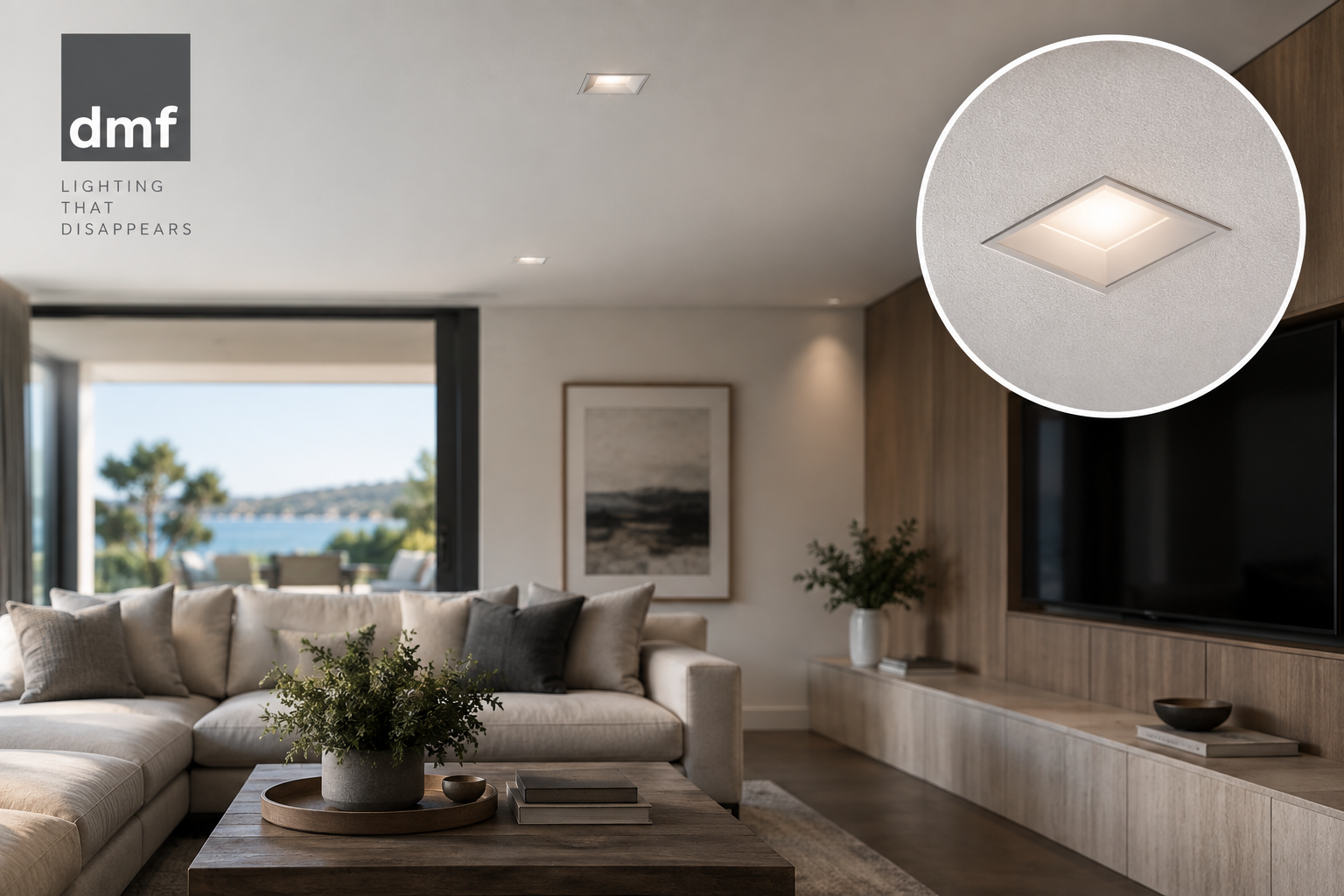

An engineering-led origin
DMF says Mark and Faye Danesh founded the company roughly three decades ago from their home, which served as an early warehouse and laboratory. The company grew around LED downlighting, modular construction, and the engineering problems that appear when a fixture needs to become smaller without becoming harsh or inefficient.
That origin helps explain the brand’s emphasis. DMF is not primarily selling a decorative pendant or a statement chandelier. It is addressing the optics, trim, driver, beam control, and maintenance questions behind recessed architectural light.
Curious what this looks like in your own house?Contact the Daisy Gulf Coast team to understand the possibilities.
Small apertures, real consequences
A smaller opening can make a ceiling look cleaner, but it does not automatically make the light better. The LED, lens, housing, cutoff, and beam spread all need to work together. If the source is too exposed or the beam is poorly aimed, a minimal fixture can produce more glare, not less.
DMF’s product families include modular downlights, small-aperture fixtures, cylinders, and concealed linear systems. Those categories are useful because rooms rarely need one type of light. A kitchen may combine focused worktop illumination with softer perimeter light. A hallway may need a low-glare path, while artwork needs adjustable accent control.
Fixture is not the same as lighting control
DMF makes the light source and fixture. Lutron and other control platforms determine how the light behaves over time. The two decisions should be coordinated, but they solve different problems.
That distinction is important in a smart home. A beautiful fixture can still be poorly grouped, overlit, or left at one intensity all day. The fixture provides the optical instrument. Scenes, dimming, sensors, and schedules determine how the instrument participates in the home.
The fixture provides the optical instrument.
What designers should examine
The useful questions include color consistency, dimmer compatibility, trim visibility, service access, and the way a fixture handles low levels of light. Coastal projects may also require attention to exterior exposure, corrosion, and the relationship between indoor and outdoor color temperature.
DMF’s modular approach can make future changes easier than a sealed, single-purpose fixture, though modularity does not remove the need for careful specification. The product should be matched to ceiling construction, room height, finish, and intended use.
DMF is compelling for homeowners who want the ceiling to recede while the room remains carefully lit. Its contribution is less about making technology invisible as a novelty and more about treating the light source as part of the architecture.