From early automation platform to broader ecosystem
Control4 was founded in 2003 by Eric Smith, Will West, and Mark Morgan, and introduced its first products in 2004. The company emerged during the early professional-home-automation market, when a unified interface was still a specialized proposition.
Control4 later merged with SnapAV in 2019. The combined organization became Snap One in 2021, and Resideo acquired Snap One in 2024 before integrating it into the ADI Global Distribution segment. Those ownership changes matter because distribution, dealer support, and product access shape the experience of a platform as much as its software does.
Those ownership changes matter because distribution, dealer support, and product access shape the experience of a platform as much as its software does.
Curious what this looks like in your own house?Contact the Daisy Gulf Coast team to understand the possibilities.
What the platform coordinates
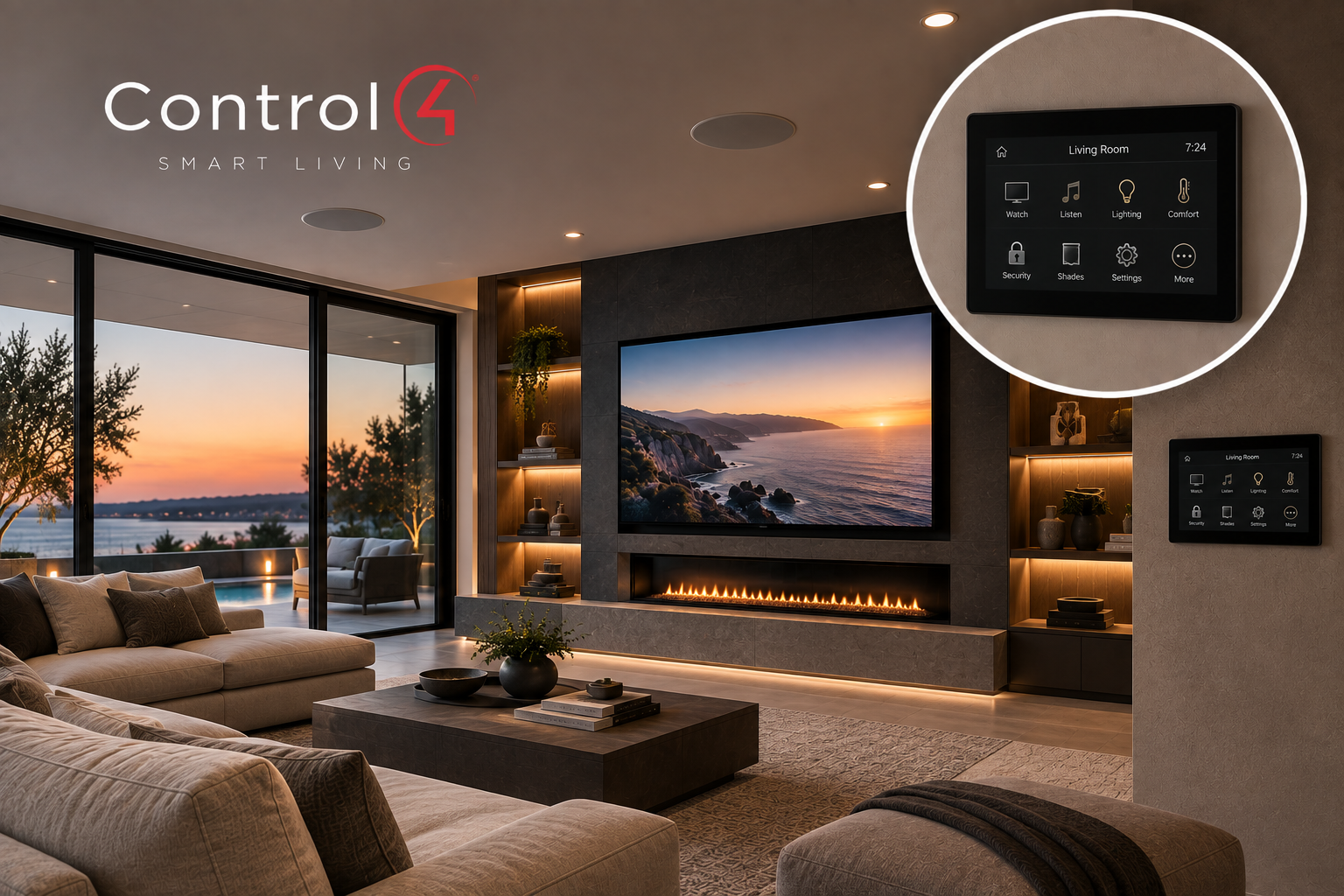
Control4 can provide one interface for systems that would otherwise live in separate apps or remotes. A wake-up scene might raise shades and bring up soft light. A leaving scene can adjust climate, secure doors, and turn off selected loads. A media scene can prepare the room without requiring the homeowner to identify the correct source first.
The value is in the relationships. Control4 does not make every product identical, and compatibility should be confirmed during design. A system still depends on network stability, programming, equipment selection, and the quality of the installation.
Why integrators continue to use it
Control4 is designed for professional configuration through authorized integrators. That model supports more complex projects, but it also means the homeowner is choosing a service relationship as well as a technology platform.
For a large Gulf Coast home, that relationship can be useful. Multiple floors, outdoor zones, shades, lighting, security, and entertainment create a level of overlap that is difficult to manage product by product. A professional can also establish permissions, backups, remote support, and a more deliberate user experience.
Where a simpler system may be better
Control4 is not automatically the right choice for a small apartment or a handful of independent devices. Its strengths appear when coordination, consistency, and service matter enough to justify a full platform.
The homeowner should ask what happens if a device is discontinued, how the system is documented, who can service it, and which functions remain available during an internet outage. Those questions are not objections to integration. They are part of choosing it responsibly.
Control4 earns consideration when the home needs one coherent language across many systems. The platform is strongest when that language is designed around the people who live there, not around a catalog of compatible products.